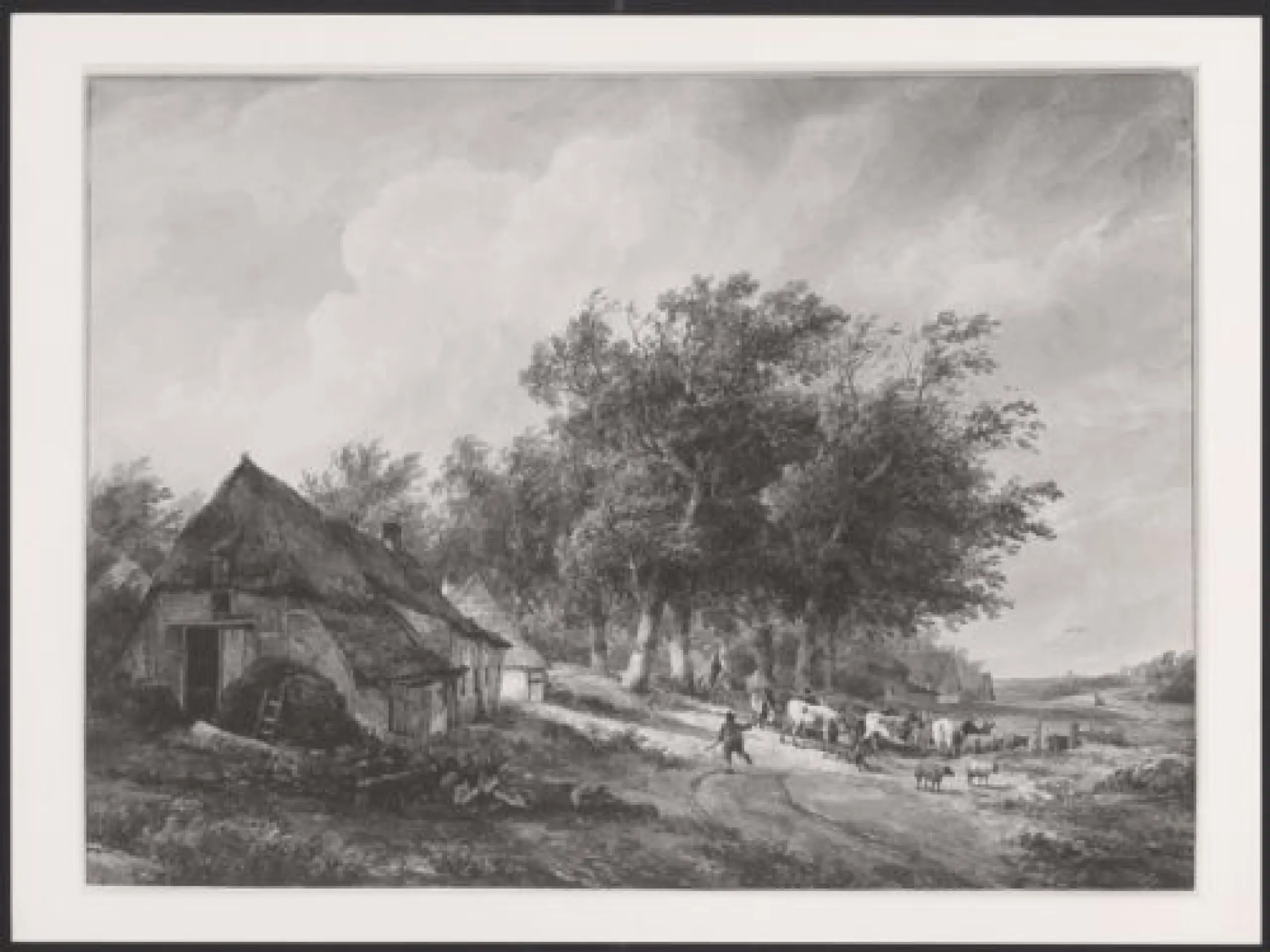
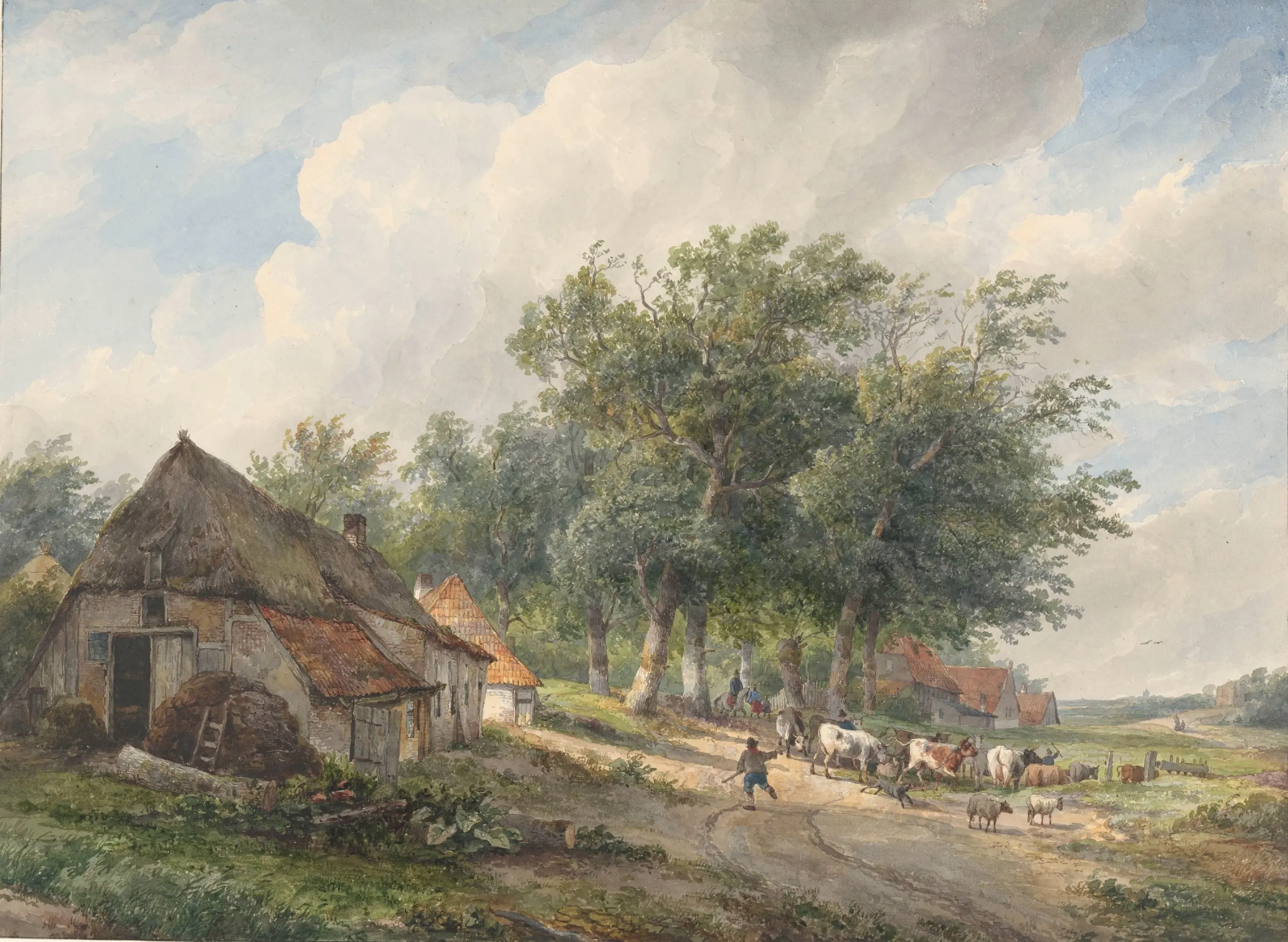
Landscape with farms and cattle
- Artist
- Wijnandus Johannes Josephus Nuijen (1813-1839)
- Year
- 1829
- Genre
- landscape
- Keywords
- Landscape, cattle, farm, forest
- Category
- watercolor
- Support
- paper
- Technique
- indian ink
- Composition
- horizontal
- Measurements
- 33.2 x 45.3 cm
- Signed
- bottom left, W.J.J. Nuyen Bz f 1828 onduidelijk
- Location
- Museum depot
- Owner
- Rijksmuseum Amsterdam, collectie Felix Meritis nummer 99. Bruikleen van de Gemeente Amsterdam
Description
Source: 1997 Langs velden en wegen pages 212-213
Landscape with farmhouse, 1829
Landscape with farmhouse, 1829 Watercolor and pen in brown and grey, over a pencil sketch, locally reinforced with gum or egg white, border line with pen in grey, 334 x 455 mm. Annotated on the reverse (later) W.J.J. Nuyen.
Collector's mark: Felix Meritis (1889; L. 924) on the reverse. Rijksprentenkabinet, Rijksmuseum, Amsterdam (inv. no. RP-T-FM-99)
The visual arts department of the Amsterdam society Felix Meritis awarded several prizes annually in the early nineteenth century. In 1829, one of the commissions read: A landscape with a farmhouse, populated with some cattle being driven, in stormy weather, to be executed as a colored drawing. The works had to be submitted anonymously and accompanied by a motto. Of the only three watercolors submitted, Wijnand Nuyen's was awarded first prize. This earned the then 16-year-old artist a silver medal of honor and likely the status of a child prodigy. Unfortunately, the considerations that led to this assessment and the names of his two competitors are unknown.
The watercolor is sketched quite freely with the brush for its time, and Nuyen did not pay too much attention to details, as can be seen in the foliage on the right in the foreground. Moreover, the walls and roof of the farmhouse show how much he tried to build up the color planes as vividly as possible using different shades.
Partly inspired by the commission, Nuyen created a landscape with an emphasis on movement. The group of trees growing to the right, the shadows, and the passing dark clouds, as well as the running man in the foreground and the herd of cattle, all contribute to this. Naturally, a vista is situated precisely in the direction of all that movement.
Exhibitions
Sources
- 1977/1978 catalog 'Wijnand Nuyen 1813-1839 romantic works' exhibition The Hague 1977 (John Sillevis / Nini Jonker) , nummer 66 pagina 92
- 1985 book 'Dutch watercolors from the 19th century' J. Sillevis, nummer 46 met illustratie zwart/wit
- 1993 Catalog tentoonstelling Rijswijk ‘The friends of Wijnand Nuijen’ Henk Dinkelaar, afbeelding 1.04 pagina 13
- 1997 boek 'along fields and roads' Rijksmuseum Amsterdam, page 212-213
Provenance
- 1899 Rijksmuseum Amsterdam collection Felix Meritis nummer 99. On loan from Amsterdam City
Media